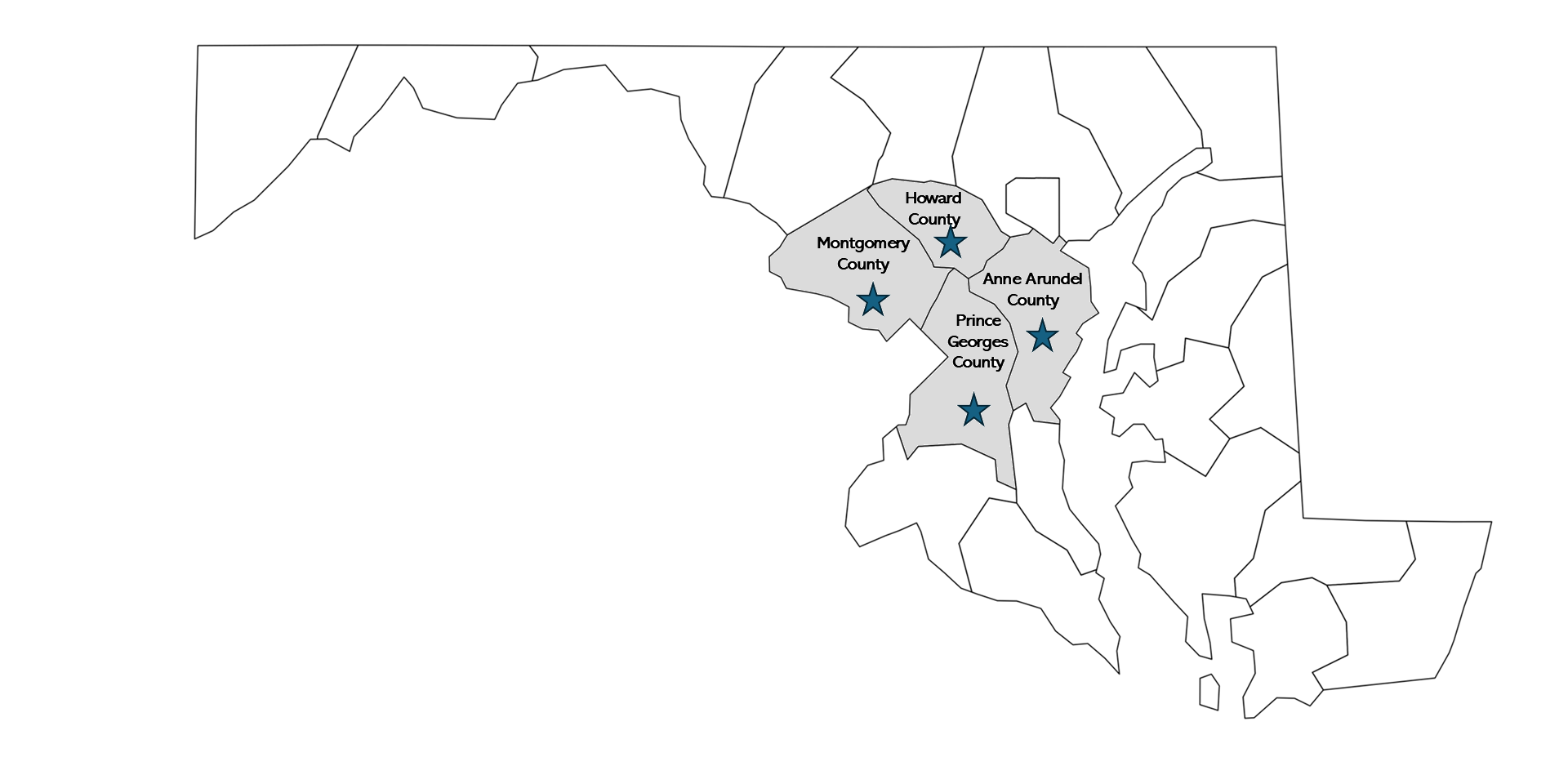
The Bayside Planning Group is a trusted and well established Maryland Employee Benefits firm (based in Virginia) providing Group Health Benefits and other Employer Consulting Services to companies operating in and throughout the cities and townships of the following Maryland Counties.

In Maryland, who you choose as your employee benefits partner can make a big difference when it comes to your benefits offering, healthcare costs, and employee satisfaction. We provide employers with what matters most in Maryland Employee Benefits.
It’s our job to stay abreast of the constantly changing employee benefits market. With expertise in areas of industry, group size and other demographics, we help you help you take advantage of new and emerging benefits that may better fit your organization’s needs and budget.
Whether benchmarking competitor plans or evaluating the many different vendors and plans available, our comparative analysis helps you select options that deliver the best health benefits to your employees, for their money and yours.
Our long-standing relationships with Maryland’s top carriers and vendors allow small and medium-sized employers to attract top talent by offering perks and rewards that might not otherwise be available to them.
Employee benefits are one of the largest company expenditures, so it’s important to have a benefits partner that will help you establish a multi-year blueprint for optimizing your group benefit plan. We focus on both current and future needs, and provide strategies to ensure your plan supports your overall business employee retention and growth plans, while keeping your year-over-year budgets sustainable.
Studies consistently show that companies who offer health, life, dental and other health related perks benefit by having a healthier, more productive workforce. But, even the best benefits may fall short of expectations if not communicated to your employees. We fill in the “health insurance knowledge gap” by simplifying and educating employees on their benefits, leading to informed, cost-appropriate health care choices, and ultimately, a happier and healthier workforce.
Is your organization compliant with Maryland’s HR laws and regulations? If you have employees in Maryland, it’s important to know what state and federal regulations apply to your business. For instance, employers in Maryland two years and older are required to participate in the state’s retirement program for employers, which is designed to give Marylanders a way to save for retirement through payroll deductions (see more below). Additionally, while the state does not mandate health coverage, Federal law mandates employers with 50+ FTE provide health benefits with MEC (minimum essential coverage) as set forth in the Affordable Care Act. In Maryland, an ICHRA can satisfy the Mandate, if certain conditions are met. An ICHRA allows employers to reimburse employees for individual health plans that satisfy the minimum essential coverage (MEC) requirement, which is sometimes less expensive than employer sponsored health coverage. Knowing the nuances of Maryland law can help you stay ahead of the curve and avoid costly penalties and fines.
Please fill out the following online form and we will contact you soon.
Retirement Benefits Required by Maryland: If an employer has been established beyond two years, and has automatic payroll, they must offer a retirement plan OR participate in MarylandSaves, an IRA program created by Maryland to expand access to retirement savings and economic security for Marylanders.
Health Benefits Required by Maryland Employers: As stated above, Maryland state law does not require health benefits be provided to employees, however, Federal Law (the ACA) mandates that Maryland employers provide health benefits to employees if they have 50 or more full time employees.
Leave Required by Maryland Employers: Maryland law provides for paid and unpaid leave, such as the mandatory Maryland Earned Sick and Safe Leave (under the Healthy Working Families Act), in which one hour of leave is earned for every 30 hours worked, up to 40 hours per year and can be used for medical reasons, maternity, domestic violence issues and more. Additionally, Maryland’s Family and Medical Leave Insurance (FAMLI) Program (employers and employees contribute to a fund) will offer up to 12 weeks of job-protected paid leave for serious health conditions or family caregiving, with benefits beginning in 2026. Other Maryland laws address benefits for jury duty, military obligations, and crime victim leave. Some Maryland employers will be also be required to offer six weeks of unpaid leave for the birth, adoption, or foster placement of a child.
Other Benefits: Maryland requires employers to pay state unemployment insurance (UI) taxes to fund the unemployment benefits program for their employees. Additionally, nearly all Maryland employers are legally required to provide workers’ compensation insurance to cover their employees for work-related injuries or illnesses.
Employer/Employee Rights: Maryland is an at-will employment state. At-will means that employers and employees can end their relationship anytime, for any reason, without notice. Since Maryland IS NOT a right-to-work state, employees in unionized workplaces can be required to join the union or pay union dues as a condition of employment.
Wage Laws: Minimum wage in Maryland is currently $15 per hour, with Montgomery county having their own minimum wage between 14.50 and $16.70 depending on size of employer.
Drug Laws: Drug testing for job applicants and employees in Maryland is legal.
An Health Reimbursement Account pairs a high deductible, low premium health insurance plan with a tax-favored savings account to help cover the high deductible. The plan requires that the employer contribute to the savings account. The employer determines a monthly, tax-free allowance amount that the employees can use to buy qualified medical costs, and in some cases, individual health coverage. The account can be used to reimburse employees for co-pays and other qualified expenses submitted by the employee, prior to the deductible being met.
Two modern, popular stand-alone health reimbursement arrangements (HRAs) are the QSEHRA and the ICHRA that offer employers an affordable, personalized benefits option. The GCHRA is more traditional and only works with employer-sponsored group health plans.
A Qualified Small Employer Health Reimbursement Arrangement (QSEHRA) is a tax-advantaged, employer-funded health benefit designed for small businesses with fewer than 50 full-time equivalent (FTE) employees. It allows employers who do not offer a traditional group health plan to reimburse employees for individual health insurance premiums and other medical expenses on a tax-free basis.
An Individual Coverage Health Reimbursement Arrangement (ICHRA) is an employer-funded, tax-advantaged health benefit that allows employers of any size to reimburse employees for individual insurance premiums and qualified medical expenses. It is a flexible alternative to traditional group plans, letting employers define a budget while employees choose their own coverage.
A group coverage HRA (GCHRA), often called a traditional HRA, only works with employer-sponsored group health plans. Businesses that offer group coverage can use the GCHRA to supplement their benefits and help employees cover out-of-pocket medical costs. Only employees enrolled in the employer’s group plan are eligible to participate in the benefit, as it doesn’t coordinate with individual health coverage.
Level-funded health plans (aka partially or shared funded health plans) allow small employers to take advantages of all the cost saving and benefit design features of a self-insured plan. Typically, self-funded plans have been designed for larger groups. However, in today’s market, any small or large group could benefit greatly by the cost saving opportunities of a level-funded group health plan plan.
An employer will select any of the fully insured plans that the carrier offers. Then rates will be determined by the group’s claim history. Next, stop-loss insurance is added to protect against catastrophic claims. Since the carrier will handle the administration of the plan, there is no need to hire a separate vendor to handle claims and processing.
The premiums for level-funded health plans are generally 20% to 30% lower than fully insured plans because the risk is reduced by combining self-insured claims funding with stop-loss insurance, creating a predictable, level monthly payment that acts like a premium while protecting employers from high-cost claims. Additionally, an employer may save even more by implementing wellness programs into the benefit programs, often resulting in healthier employees and a surplus refund at the end of the year. Our thorough plan analysis will help you determine if level-funding is right for your company.

Delaware
Maine
Massachusetts
Maryland
New Jersey
North Carolina
Pennsylvania
Virginia
West Virginia

Please fill out the following online form and we will contact you soon.
Employees have access to preventative medicine such as flu shots, mammograms, colonoscopy, heart and cancer screenings and more.
Employees have access to programs such as smoking cessation, substance abuse help, financial wellness seminars and more.
Onsite or offsite nutritional classes, access to other nutritional resources such as diet apps, blogs and other subscriptions. Members may also qualify for special assistance with diabetes management and more.
Your employees can consult with a licensed physican, via phone or video for litle or no copay. Physicians can consult on health matters, diagnose medical conditions, and prescribe medications. Employees also have access to a nurse hotline 24/7 for general medical advice.
Biometric screenings onsite or at provider offices, aimed at creating awareness, improving health and reducing claims of your most at risk employees.
Onsite, offsite or virtual physical fitness classes or special group events, such as 5K runs. Discounts to gym memberships. Access to additional resources such as fitness trackers, blogs, subscriptions and more.
A Premium-Only Plan is a win-win solution for both you and your employees. It allows allows employees to purchase their own individual insurance with pre-tax dollars, decreasing taxable income and increasing take-home pay. It also reduces the employer tax liability and generally reduces premiums. In other words, both employees and employers can potentially save thousands annually in taxes and premiums combined.
Employees elect a set amount of pre-tax dollars to be deducted from each payroll. Then, the employee purchases an individual health insurance policy from a carrier of their choice. Accordingly, the employee is responsible responsible for paying the monthly premiums directly to the carrier. Then, the employee is then reimbursed by the employer for the monthly premium with the pre-taxed dollars. After a thorough plan analysis, we can help you determine if a POP program would benefit you and your employees.
We help retirees and other eligible employees tackle the challenges of ever increasing premiums and health care costs by purchasing a quality Medicare Supplement. While there are many options, the best coverage is a plan that leaves you with the least expenses, and has the lowest premium.
Medicare Supplement Insurance policies complement your Original Medicare Parts A and B. They cover some, if not all, of the expenses that Part A and B do not cover, like co-pays, deductibles and other charges.
There are many different types of Medicare Supplement policies available, however they are regulated so the benefits for these various policies (known as Plan A through N), are all the same regardless of the carrier. However, premiums can vary greatly among carriers.
National surveys have shown that Short Term Disability and Long Term Disability remain of high importance for most employees. Thus, savvy employers attract and retain top talent by offering both STD and LTD insurance as part of the employer paid benefit package or as a voluntary (worksite) benefit.
During the time an employee is unable to work due to a qualifying disability (illness or injury), STD generally allows for income payments to the employee to begin after about a two-week waiting period and will continue to pay the employee until he/she recovers or maxes out the benefits–usually anywhere between one month to two years, depending on the policy.
During the time an employee is unable to work due to a qualifying disability (illness or injury), LTD generally allows for income payments to the employee to begin after about a 90-day waiting period. However, it could be much longer depending on the policy. The policy will pay the employee far longer than STD–for a few years, up to age 65, or even for life.
Employees are more productive when they feel secure that their loved ones will be taken care of, in the event of illness or an untimely death. Thus, you should consider life insurance a key part of the benefit package for your employees. And, also a valuable tool in attracting top talent.
Whether employer paid or voluntary, a good life insurance policy provides for an employee’s final expenses, taxes, and mortgage. Additionally, it may even pay for their children’s education.
This type of life insurance builds cash value which is sometimes used as collateral for loans, if needed. However, most employers only offer basic term life insurance (see below), but also offer permanent life insurance on a voluntary basis. Even so, employees appreciate the opportunity to widen their safety net.
This type of life insurance does not build cash value. However, it will pay a set amount to the named beneficiary upon the death of insured within the stated term. Additionally, some policies may also make payments upon terminal or critical illness.
A Flexible Spending Account is a cafeteria plan under Section 125 of the tax code. It is a tax-favored savings account and is funded solely by the employee through regular pre-tax payroll deductions. The funds from the account can be withdrawn tax-free to pay for eligible medical, dental, vision, prescription and dependent daycare expenses. Additionally, employees elect how much they want withdrawn from each pay period, which can be changed annually or upon a qualifying event such as marriage or divorce. For example, the average working employee in America spends more than $1,000 annually on these types of benefits. By participating in a FSA, an employee always has cash to pay for these expenses, and as an added benefit, their taxable income is reduced which also increases the percentage of pay they take home.
Employees always appreciate dental & vision coverage as part of the benefits package. We offer both dental and vision as part of the employer sponsored package or on a voluntary basis.
Studies have shown that regular dental exams help employees to stay healthier and more productive in the work place. Additionally, you can detect serious underlying conditions such as heart disease and diabetes, through regular dental exams. In fact, the National Association of Dental Plans and the Centers for Disease Control have performed studies that show that employees with dental insurance have better attitudes and are less likely to suffer from depression, a common condition in today’s fast-paced world.
Dental insurance offers a variety of diagnostic, preventative care and corrective services. This includes cleanings, exams, x-rays, fillings, root canals, orthodontia for children, and emergency care while traveling.
Similar to dental policies, vision plans are inexpensive and save employees money on routine eye care. Examples of care include exams, eyeglass frames and lenses, contacts, and even discounts on procedures like LASIK. Additionally, monitoring your eye health with regular exams helps to prevent serious eye diseases like glaucoma and cataracts. In addition, regular eye exams help to detect early stages of diabetes, high blood pressure, and high cholesterol.
When employers self-fund their own group health plan, they will benefit from a significant savings in the overall cost of their benefit programs. For example, savings may be in premiums, increased cash flow and certain tax advantages. Additionally, employers have more control over the benefits that the plan offers. Typically, self-funding was not available to small employers in the past. However, today self-insured group health plans are considered to be good options for both small and large employers.
A self-funded group health plan requires the employer to become the insurer. Most often, employers will partner with a PPO to provide services for the plan. Then, a third party administrator (a TPA) is engaged to handle claims and processing. Self-insured employers run the risk of large catastrophic claims. As a result, they need to purchase stop-loss insurance to protect themselves in such an event. Even with the additional expense of stop-loss insurance, employers save a significant amount of money on premiums and other advantages.
An HMO group health plan requires group members to obtain their health care services from doctors and hospitals affiliated with the HMO. Thus, members are required to designate a primary care physician within the HMO. Then, the primary care physician treats and directs health care decisions. In addition, the primary care physician coordinates referrals to specialties within the HMO network. Accordingly, HMOs offer access to a comprehensive package of covered health care services in return for a prepaid monthly amount (or “premium”). However, most HMOs charge a small co-payment depending upon the type of service provided.
If you belong to a PPO group health plan, you will save the most money on healthcare if you use providers within the PPO network. Thus, if providers outside of the network are used, it is possible that those services may be covered only partially or not at all. Also, deductibles must be met on this plan before some services will be covered. PPOs require a co-pay for physician visits and some other healthcare services. However, the great thing about a PPO is it’s rich network of quality doctors and healthcare facilities, and the ability to utilize healthcare services outside of your deductible. For example, doctors visits.
An HSA combines a high deductible, lower premium group health insurance plan (PPO) with a savings account. Accordingly, both employer and employee can contribute, tax-free, to the savings account. Then, the account is used to help fund the deductible and other qualified medical expenses. Once the deductible is met, the insurance starts paying.
An HRA combines high deductible, low premium health insurance plan with a tax favored savings account. Consequently, this plan requires that the employer contribute to the savings account. Then, the account can be used to fund co-pays and other qualified expenses submitted by the employee, prior to the deductible being met.
Single, Dual or Triple Option Plans offer eligible employees a choice between several different types of plans as described above.
Through our thorough analysis and plan design process, we can help you determine which traditional health plan is right for your company.